








Greater Than the Sum
@ John Michael Kohler Arts Center
608 New York Ave, Sheboygan, WI 53081
Opening Saturday, October 24th, from 2PM - 3PM
On view through Sunday, February 7th
Greater Than the Sum: Practices of Gathering, Reuse, and Assemblage
The artists included in the group exhibition each utilize practices of gathering, reuse, and assemblage. Through sculpture, fiber, found objects, and collected materials, they demonstrate how a component’s value is not found solely in its advertised or initial use, but in its ability to connect in countless ways with other beings, ideas, and objects to create complex, stronger, and richer collectives and meanings.
Working with materials carrying rich and often unknowable histories, the artists create physical manifestations of the relationships between material, cultural, and environmental experiences and histories. Their works reveal practices rooted in observation, collection, collaboration, and transformation.
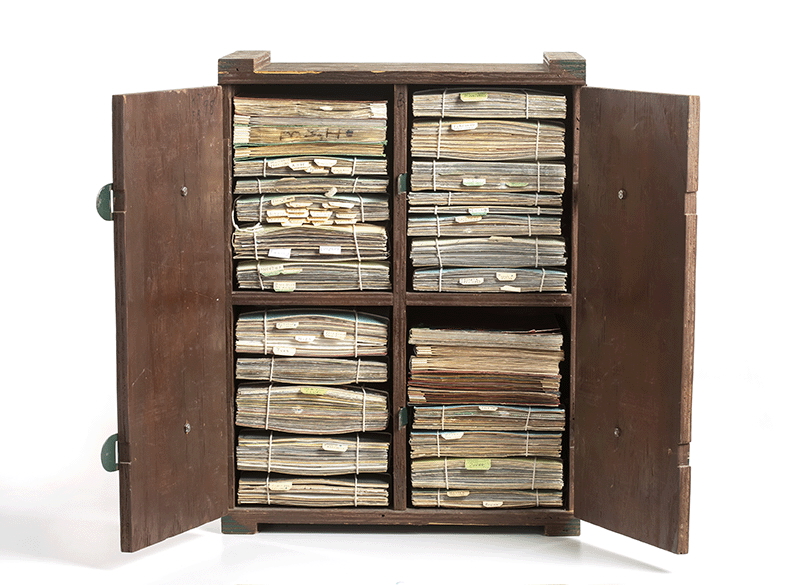
The exhibition includes environmentally focused assemblages by Carolina Caycedo; spiritually charged sculptures by Arthur Simms; wrapped fiber works by Judith Scott; Kea Tawana’s custom-built trunks and systems of organization; and Lenore Tawney’s gathered materials, collaged boxes, and assemblages drawn from her studio practice. Together, the artists offer a range of models for connection, steeped in community and environmental contexts.
Through their artworks and artistic practices, the artists demonstrate the transformative and empowering nature of coming together, of beings and things, with our various stories, experiences, skills, and strengths. In this vein, artistic practices of gathering and reuse demonstrate that an interconnected assemblage, community, or ecosystem embodies a vaster potential value—that is, Greater Than the Sum of its parts.
Greater Than the Sum Gallery Walkthrough
Step inside Greater Than the Sum: Practices of Gathering, Reuse, and Assemblage with artists Carolina Caycedo and Arthur Simms and Lenore G. Tawney Foundation Director Kathleen Nugent Mangan.
October 24 @ 2:00 – 3:00 pm
Arts Center
Carolina Caycedo
Carolina Caycedo (b. 1978, London, United Kingdom) is a Colombian multimedia artist based in Los Angeles. Her work is rooted in environmental research focusing on the future of shared resources, environmental justice, energy transition, and cultural biodiversity. Through her studio practice and fieldwork in ecosystems and with communities, Caycedo invites observers to consider the unsustainable pace of consumption under capitalism and how we might embrace resistance and solidarity. Caycedo works across media, including, but not limited to, sculpture, assemblage, film, artist books, and large-scale installations.
Caycedo received a Master of Fine Arts from the University of Southern California and a Bachelor of Fine Arts from the University of Los Andes in Bogotá, Colombia. Her work has been exhibited globally and is included in several international permanent collections such as Cantor Arts Center, Stanford; Escala Collection, University of Essex; Hammer Museum, Los Angeles; Hood Museum, Dartmouth College; The Huntington Art Museum, San Marino; Institute of Contemporary Art, Boston; Kadist Art Foundation; Los Angeles County Museum of Art; Migros Museum, Zürich; Mohn Art Collective: Hammer, LACMA, MOCA; Museu de Arte de São Paulo; Museum of Contemporary Art Chicago; Museum of Modern Art, New York; Muzeum Sztuki, Łódź; Orange County Museum of Art; Rollins Museum of Art, Winter Park; Seattle Museum of Art; Seoul Museum of Art; Sharjah Art Foundation; Tate, London; Monterey Park, California; and Whitney Museum of American Art, New York amongst others.
Judith Scott
Judith Scott (1943–2005) was a visual artist, isolated from outside influence due to Down syndrome, deafness, and decades of institutionalization. She created fiber sculptures during her tenure in the Creative Growth Studio from 1987 until her death.
Scott was born in Ohio with her fraternal twin sister Joyce in 1943. Scott was institutionalized at the age of seven at the Columbus State School. She remained in state institutions until 1985, when her sister became her legal guardian and brought her to California. Scott entered the Creative Growth Studio, initially displaying little artistic interest until a visiting artist workshop with the sculptor Sylvia Seventy, during which Scott discovered the medium of fiber art. Her wrapped sculptures, abstract in shape, were sourced from hand-built armatures made of discarded or found materials, often concealing an inner structure or cache of items. Her practice was marked by her independence, self-direction, and for never repeating a form or color scheme in her multimedia textile sculptures.
Scott’s work has been exhibited at the Brooklyn Museum in New York in a retrospective exhibition and is part of the permanent collection at the Museum of Modern Art in New York, the Centre Pompidou in Paris, and the Smithsonian in Washington DC, among many others. Her work has also been shown at Gugging, Austria; the Museum of Everything, London; the Smithsonian Institution, Washington DC; White Columns, Barbara Gladstone Gallery, Gavin Brown’s enterprise, Ricco Maresca, New York; and Rena Bransten Gallery, San Francisco.
Arthur Simms
Arthur Simms (b. 1961, Saint Andrew, Jamaica) is an artist and educator based in Staten Island, New York, whose assemblage sculptures utilize found and natural materials and are often bound with rope or wire. Simms’ studio practice is guided by intuition and a rich understanding and investment in cultural traditions, particularly folk cultures of Jamaica, America, and Haiti. The resulting sculptures are constructed from materials such as toys, bottles, bicycles, and personal mementos, and resonate with narratives of connection, humor, and spiritual energy.
Simms earned an M.F.A. and B.A. from Brooklyn College, Brooklyn, New York and also attended the Skowhegan School of Painting and Sculpture, Skowhegan, Maine. His work is held in the collections of the Aïshti Foundation, Beirut; Hirshhorn Museum, Washington, DC; Museum Brandhorst, Munich, Germany; Neuberger Museum of Art, Harrison, New York; and Yale University Art Gallery, New Haven, Connecticut, among others.
Kea Tawana
Much is unknown about Kea Tawana (c.1935–2016) until she began salvaging slate, glass shards, and timber from buildings in Newark’s Central Ward during the late 1960s. These materials eventually became the makings of the Ark, an 86-foot-long, three-story ship she began building in 1982 with the intention of making it her home. She told some people she had been born in Japan, the daughter of an American civil engineer and his Japanese wife, and told others she had run away from a Native American reservation at age twelve.
It is widely accepted that she worked itinerant jobs in the South before hopping freight trains to the New York state area. On the east coast, she worked in shipyards, on construction sites, and in theater rigging, acquiring all the skills she needed to build the Ark, a vessel she hoped to christen AKE Matsu Kaisha (Red Pine). After she was forced to dismantle her hoped-for home, she moved to Port Jervis, New York, where she lived until her death in 2016.
Lenore Tawney
1907–2007
Lenore Tawney (Leonora Gallagher) was born in 1907 in Lorain, Ohio, one of five children. She moved to Chicago at the age of twenty, where she worked in publishing and attended classes at the School of the Art Institute of Chicago and the Institute of Design. Her marriage to George Tawney in 1941 was cut short by his premature death two years later. Compelled by her artistic ambitions, Tawney moved to New York City in 1957. She lived and worked in a series of lofts, which became works of art in their own right.
Tawney’s innovative interpretations of traditional practices were central to shifting the perception of weaving from a utilitarian craft to fiber art as we know it today. Her experimentation with open-warp techniques resulted in gauzy, loose works of a nonfunctional, free-flowing nature. In what she referred to as “woven forms,” Tawney’s unorthodox sculptural works took weaving beyond the expected flat rectangular format, moving fiber art off the wall and into three-dimensional space. Tawney’s interdisciplinary oeuvre also spanned drawing, collage, and assemblage. Tawney died in 2007 at the age of one hundred. In 2019 the John Michael Kohler Arts Center worked closely with the Lenore G. Tawney Foundation to acquire hundreds of key components from Tawney’s last studio environment with assistance from Kohler Foundation, Inc.
Official Website
More events on this date
Tags: Arthur Simms, Carolina Caycedo, Greater Than the Sum, John Michael Kohler Arts Center, Judith Scott, Kea Tawana, Lenore Tawney, Wisconsin
« previous event