








Clotilde Jiménez: Éramos silencios
@ Mariane Ibrahim
437 N Paulina St, Chicago, IL, 60622
On view through Saturday, October 31st
Mariane Ibrahim is pleased to announce Éramos silencios, a solo exhibition by Clotilde Jiménez, on view in Chicago from September 16 to October 31, 2026.
In Éramos silencios, Clotilde Jiménez presents works rooted in Puerto Rico that reflect on family lore and inherited silences, to construct personal mythologies drawing from what is known and what can only be sensed. In his early adulthood Jiménez spent time in Mayagüez, a town on the west coast of Puerto Rico, deliberately developing relationships with his maternal family elders. His grandmother and grandfathers are the newly introduced protagonists of this story. One of them is the man known as Tío Juan, the central figure of the family in the island and key to his understanding of family, place, and inheritance. A decade after Jiménez had developed a relationship with him, his grandmother confirmed that the man he had known as an uncle was actually his biological grandfather. Despite the silences, a paternal relationship had developed intuitively. Across painting, collage, drawing, and sculpture, the exhibition shares a journey toward reimagined forms of family, identity, spirituality and queer existence.
Jiménez approaches each exhibition as an author does a book, unfolding each chapter of a visual memoir that evolves artistically alongside him. By this point in the overarching narrative, he has introduced characters and symbols that represent himself, family members, and archetypes of Blackness and masculinity alongside still lives and other symbolic natural elements. Éramos silencios extends this trajectory, with works that ponder what is transformed in the process of remembering. In The Contest, his previous exhibition in Chicago, Jiménez tackled the impact of his absent father –a boxer and body builder– and imposed notions of masculinity through the metaphor of sport. Now, Jiménez explores the relationships between generations, the silences surrounding them, and the stories that are inherited.
In all his work, there is a positing of alternatives to the question of what Blackness is, and what does it represent in different places and settings. Born in Honolulu to an African American father and Puerto Rican mother, raised in Philadelphia, educated in Cleveland and London, and now based in Mexico City, he draws from the cultural, political, and social environments of each place he has inhabited. Jiménez grew up with what he calls a bifocal worldview, informed by his Black American and Caribbean—specifically Puerto Rican—heritage, which, in adulthood, has expanded to encompass the Mexican context in which he lives and raises his family.
This gave him a Black American consciousness of systemic oppression, but also the cultural and spiritual mechanisms by which people stubbornly persist. In contrast, learning from his Puerto Rican lineage required intentionality and a willingness to reckon with the contradictions and shifting racial categories of the Caribbean. Jiménez started going to Mayagüez when he was 18 and then returned annually throughout his twenties, sometimes staying for months at a time. These experiences introduced Jiménez to a racial vocabulary that operates differently from the categories with which he grew up in the United States. It was in Puerto Rico, particularly through Tío Juan, that Jiménez—who identifies as Black, African American, and Afro-Latino—encountered the term trigueño a specifically Puerto Rican and Caribbean racial category. Trigueño is a fluid concept dependent on social context and applicable to people with a wide range of skin tones. Though not a binary, it is nonetheless defined by proximity to Blackness. The distinction is significant to Jiménez’s work because it reveals how racial identity changes according to place, history, and the language available to describe oneself.
His choice of materials as well as the conceptual concerns of his work continually negotiate the intersections of Blackness, Latinidad, memory and spirituality. Originally trained as a printmaker, Jiménez turned to mixed media shortly after graduating from college, when limited access to printmaking equipment and an abundance of paper around him opened another possibility. Printmaking is still fundamental to how Jiménez approaches collage and the construction of images through layering, fragmentation and repetition. His works include magazine cut outs saved over the years, fabrics from all over the world and Mexican craft paper. Through sketching, his ideas gradually evolve into compositions in which collage serves as both a formal strategy and a metaphor for identity itself. Gender, ethnicity, accent, and his different cultural backgrounds are all layers of his own collage.
Now, after several years in Mexico City, where he encountered the colonial archive’s blunt classifications in casta paintings, Jiménez has begun to develop what he calls “a theory from the middle.” A framework for imagining futures shaped by the hybridity colonialism produced. This is the mindset from which the latest chapter of Jiménez’s memoir emerges.
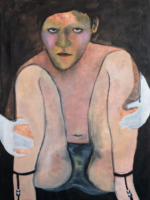
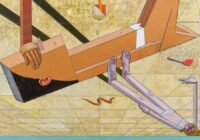
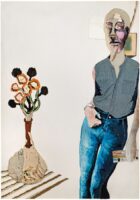
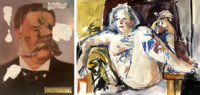
Refloating his memories from Mayagüez, Tío Juan and entangled familial ties is essential to this exhibition. Family lineage is explored in Los Varones, a generational portrait featuring his grandmother Renée Jiménez, grandfather Gabriel and Tío Juan. The work hints at how the experiences of one generation shapes the next, as Jiménez continues to contend with inherited ideas of masculinity within the family. He also produced self-portraits, including one as Ophelia, an archetype of vulnerability, floating bare-chested in a river surrounded by oranges above and fish below. In his Flower Portal works, Jiménez delights with intricate compositions featuring exuberant flowers, oranges, fish and even a baby head and a trompe- l’œil fly––perhaps a symbol of sin––in a nod to the Dutch still lives of the Renaissance. In the multifaceted Portrait of My Mother as a Child, Jiménez depicts his mother as a young girl before she became the person he now knows. Her poignant visage —constructed out of three other faces—tells a story, possibly of inherited pain and silence. It’s a profound matter, to conceive of and empathize with one’s parent as the vulnerable being they were as children. This piece also exemplifies how drawing plays a more prominent role here than in previous exhibitions, when Jiménez would collage over an underlying sketch. Both materially and conceptually, the works are more revealing than ever.
In Invitation to the Altar, the figures are distributed in two planes: in the background, an older man plays a cuatro while a nun raises the Holy Book overlooking three women bent over the child lying on the floor. They reach out to touch him with a mix of reverence and care, in gestures reminiscent of Mexican Modernist mural art. Pink, translucent paper adds color and dynamism to the scene, casting light around the child’s head, as a hand pierces through its glow. Used throughout the works, this translucent colored paper suggests the presence of the divine.
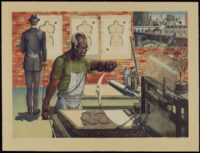
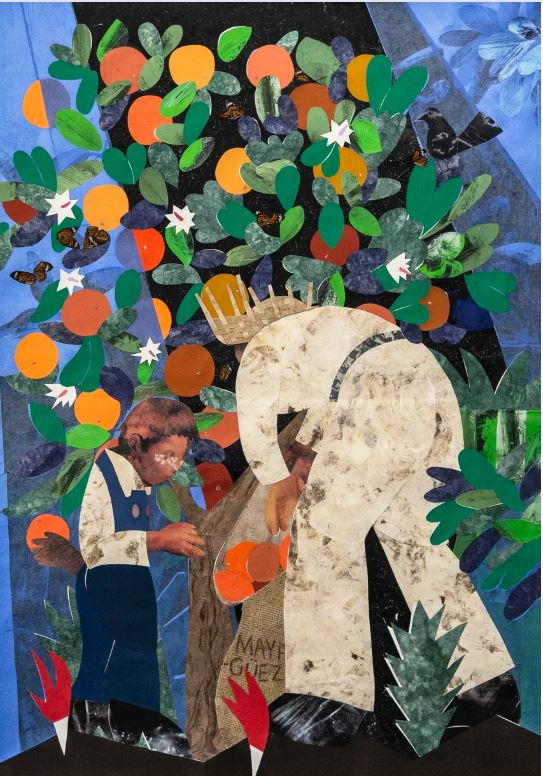
Oranges appear throughout the exhibition as a recurring motif. The fruit has many connotations across cultures but in this world the orange is metaphorically peeled to reveal increasingly personal meanings. Notably, the exhibition features painted bronze sculptures of oranges distributed along the gallery walls, like embedded memories. In China de Mayagüez, an orange tree towers over a child—presumably Jiménez—and Tío Juan, who is dressed as a jíbaro, the farmer figure long associated with traditional Puerto Rican identity, as they gather fruit in a jute bag. As an artist whose work is deeply autobiographical, this piece reflects a moment of recognition when he began to understand that certain family ties were more intertwined than he had been told. Jiménez also doubles down on the connection between past and present, as this work references a decades-old woodblock print of his own making. While Jacob Lawrence and Romare Bearden may be his artistic forbearers in use of color, collage technique and inquiries into Black life, these works push forward into enigmatic territory.
Across several works, the fruit alludes to family, memory and legacy, but in this evolution of personal mythology, the oranges also refer to migration, transplantation and colonial movement. Moving from China to North Africa, to Europe and then onward to the Americas, the movement of oranges followed the expansion of empires and the tragedies of colonization, making their presence in these pieces inseparable from histories of displacement. Their ubiquitousness in the works has led Jiménez to think of them as being their own visual language within his practice. The idea of a “Clotilde orange” has begun to emerge, and it can be ripe, green, aging, exaggerated or transformed. Through presence, love and protection, in Éramos silencios, Jiménez conjures stories in which silence is its own form of communication.
Introductory text by curator Marina Reyes-Franco.
Official Website
More events on this date
Tags: Chicago, Clotilde Jimenez, Éramos silencios, MARIANE IBRAHIM, Marina Reyes Franco
« previous event