











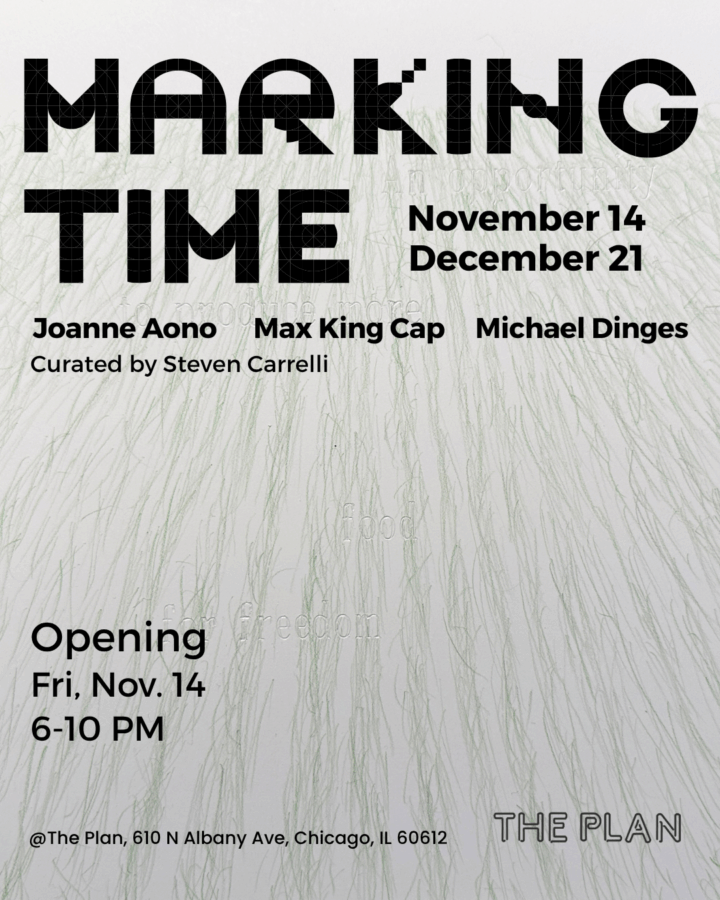
Marking Time
@ The Plan
610 N Albany Ave, Chicago, IL 60612
Opening Friday, November 14th, from 6PM - 10PM
On view through Sunday, December 21st
The works in Marking Time relate the physical labor of their making to the subjective experience of time. Through mark-making and repetition, they draw attention to time as both an individual and collective phenomenon. Each of these artists couches their personal labor in a larger cultural context that interprets the time and gives it a focused meaning. The objects so crafted become embodiments of time: the time of the artist, the time of the subject, the time of the culture that we create.
In Max King Cap’s Captive Studies, layers upon layers of hash marks tally the days of a specific person’s unjust imprisonment for a crime that they did not commit. With brush and watercolor, Cap draws the familiar clusters of four vertical marks bound by a diagonal slash. Counting the marks as one counts out the days, each linear touch of the artist’s hand marks a day of wrongful captivity. While these works may at first appear as elegant abstractions, each study’s title includes the name of the incarcerated person and the number of days they spent in captivity. Cap has described his work as “a form of metaphoric journalism.”
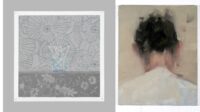
Joanne Aono’s meticulous and subtly crafted works use mark, image, and text to reflect on a broad range of relationships between agricultural labor and the effects of human activities on the natural environment. Works like Thismia Americana and American Bur Reed depict extinct and endangered plant species in the medium of silverpoint, which itself tarnishes over time with exposure to oxygen. Her Ancestral Harvest series juxtaposes images of agriculture with texts from World War II era advertisements aimed at recruiting Japanese Americans who were interred in US detention camps to work as farm laborers. The small and fragile Salt Licks are collaborations with time, drawn on the remnants of salt licks used to feed the draft mules that provide labor on the artist’s farm.
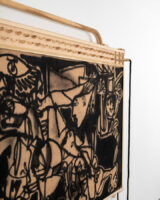
Michael Dinges adapts the folk-craft technique of scrimshaw to engrave intricate images and texts on consumer items, offering a critique of an economy that throws away its laborers in the production of throw-away goods. In works like Buffering and Pattern Recognition 7 (Micro Labor Deserves a Micro Wage), Dinges draws attention to the appropriation of unpaid intellectual labor by large technology corporations; and At the End of the Day, a Shovel is a Spoon invites reflection on the dismissive assumptions of a capitalist economy towards the work of its laborers. In these discarded and repurposed laptops and spoons, labor critiques capital, even as the careful work of the artist embodies an investment of time, attention, and perhaps even love.
The time invested by the artist makes a commensurate demand on the viewer, and all three of these artists create works that reward slow and repeated observation. They mark the organic rhythms of the natural environment, the violence of unwarranted imprisonment, and the effort of human labor. In marking the time, they are scratching for us a picture of this moment and our relationship to it.
Official Website
More events on this date
Tags: Chicago, Humboldt Park, Joanne Aono, Marking Time, Max King Cap, Michael Dinges, Steven Carrelli, the PLAN
« previous event
next event »